
Recognizing When Your Business Data Needs a Better Solution
A Complimentary KSI Executive Learning Session | 50 Minutes | Live & Interactive
Organizations have access to more data than ever before. Yet many leaders still struggle to get timely, accurate, and consistent information when making important business decisions.
Departments generate reports, dashboards, spreadsheets, and performance metrics. But having information available is not the same as knowing what it means—or how to use it effectively.
Operations managers, department heads, project managers, business analysts, and professionals responsible for maintaining, reporting, or analyzing important organizational data.
This session is especially valuable for organizations that rely heavily on spreadsheets to manage recurring business processes and want to evaluate more efficient, reliable approaches.
No database or programming experience is required.
The challenge isn’t simply collecting more data. It’s turning the data you already have into meaningful business decisions.
Microsoft Excel is one of the most widely used and valuable business tools available. From financial analysis and project tracking to reporting and forecasting, spreadsheets help organizations manage information and make important decisions every day.
But as business operations become more complex, spreadsheets are often asked to perform functions they were never intended to handle.
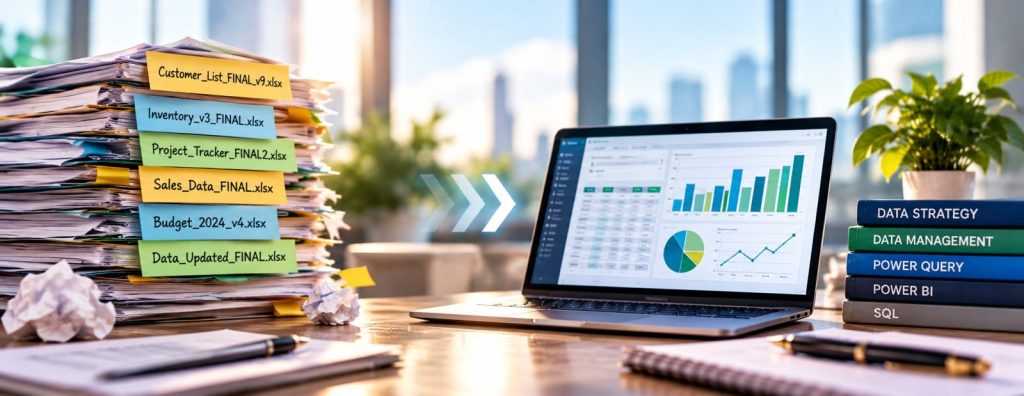
Critical business information may be stored in multiple files, shared through email, maintained by different employees, or updated manually across departments.
The result? Conflicting versions, outdated information, unnecessary duplication, and growing uncertainty about which data can be trusted.
The challenge isn’t that Excel has stopped working. It’s recognizing when your organization’s data management needs have outgrown spreadsheets.
Consider these common situations:
These challenges can create operational inefficiencies, increase the risk of errors, and limit an organization’s ability to make timely, informed decisions.
Excel remains an excellent solution for calculations, exploratory analysis, forecasting, and many everyday business activities.
However, when spreadsheets become the primary system for maintaining frequently updated, shared, or business-critical information, organizations may benefit from a more structured approach.
Databases and modern data management solutions can provide greater consistency, improve accessibility, reduce duplication, and support more reliable reporting and analysis.
The goal isn’t to replace Excel. It’s to use Excel where it adds the most value while ensuring critical business data is managed appropriately.
Join Knowledge Source Inc. for a complimentary learning session exploring the practical limitations of spreadsheets, the warning signs that indicate a need for change, and how organizations can begin transitioning toward more reliable data management practices.
Duration: 45–50 minutes, including Q&A
Format: Live, interactive virtual session
Audience: Corporate leaders, managers, and business professionals
Cost: Complimentary
Consider these common situations:
These challenges often point to something deeper than inadequate technology. They reveal gaps in how organizations define, manage, interpret, and communicate information.
Effective decision-making requires more than sophisticated reporting tools. It requires employees and leaders who understand how to evaluate information, recognize inconsistencies, ask meaningful questions, and interpret results.
Data literacy is increasingly an essential business competency, yet many professionals have never received formal training in these skills.
For many organizations, the challenge isn’t a lack of talent. It’s a lack of training and a consistent approach to using data.
Experience and professional judgment remain essential. But combining that judgment with reliable, well-understood information leads to stronger, more defensible business decisions.
Join Knowledge Source Inc. for a complimentary executive learning session exploring how leaders can strengthen data literacy, improve information reliability, and build a more effective approach to data-driven decision-making.
Duration: 45–50 minutes, including Q&A
Format: Live, interactive virtual session
Audience: Corporate leaders and management teams
Cost: Complimentary
Recognizing When Spreadsheets Have Reached Their Limits
Identify the warning signs that spreadsheets are becoming difficult to maintain, including version-control problems, inconsistent information, manual processes, and growing dependence on individual employees.
Understanding Your Data Before Choosing a Solution
Learn why effective data management begins with understanding how information is structured, what individual records represent, and how different sets of business data relate to one another.
Exploring Alternatives to Spreadsheet-Based Data Management
Gain a practical, nontechnical understanding of how databases and centralized data systems can improve information reliability, accessibility, and consistency.
Two Practical Approaches to Managing Business Data
Explore how organizations can improve their existing processes by connecting directly to established data sources or transitioning spreadsheet-based information into a more structured database environment.
Building a Foundation for Better Reporting and Analysis
Understand how reliable, well-organized data supports more efficient reporting, repeatable analysis, and the effective use of tools such as Excel, Power Query, Power BI, and SQL.