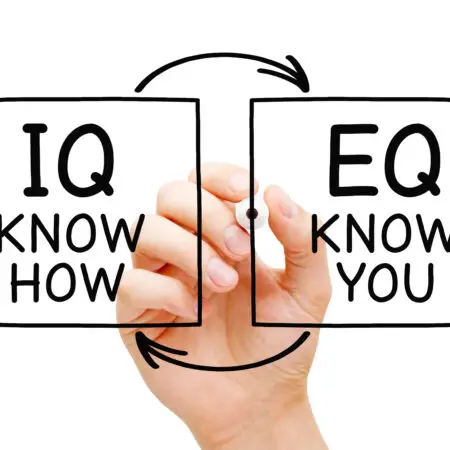
Please Note! Workshop attendees should purchase and complete the assessment in Emotional Intelligence 2.0 prior to class. Cost is approximately $25 and can be purchased on the following link:
Emotional Intelligence Assessment
Workshop Summary:
Emotional Intelligence (EI) is essential to success in every aspect of life — at work, in leadership, and in personal relationships. Research consistently shows that individuals who are self-aware, socially perceptive, and skilled in managing emotions outperform others in career advancement, decision-making, and interpersonal effectiveness.
In this interactive workshop, participants will explore the Emotional Intelligence model and its four key components: self-awareness, self-management, social awareness, and relationship management. They will examine how personal values influence emotional triggers, analyze the challenges of managing emotional responses, and practice strategies to increase emotional awareness and control. Participants will leave equipped with practical tools to strengthen their emotional intelligence, enhance collaboration, and improve overall performance in both professional and personal settings.
Learning Objectives:
• Review the concept of Emotional Intelligence and describe its four primary components.
• Explain the role of the “emotional brain” in influencing thought, behavior, and decision-making.
• Identify personal core values and recognize how they relate to emotional triggers and self-management.
• Explore emotional triggers and analyze how they shape actions and interpersonal behaviors.
• Recognize the unique challenges men and women may face in developing emotional intelligence.
• Demonstrate how emotional intelligence competencies contribute to effective leadership and relationship management.
• Apply emotionally intelligent communication techniques to build and maintain strong relationships.
• Develop strategies to enhance both personal and social dimensions of emotional intelligence.
• Create an Emotional Intelligence Action Plan outlining challenges, needed resources, measurable goals, and implementation strategies.
Observable Behaviors to Watch For:
- The learner should now be able to identify their own emotional triggers and demonstrate a deeper awareness of personal emotional intelligent levels, areas of strength, and areas in need of improvement.
- Having attended this workshop, the learner will demonstrate an increased ability to effectively influence, motivate, and manage others.
- The learner should demonstrate relationship building more competently and effectively.
- After attending this workshop, the learner should display a greater level of self-awareness, the first domain of emotional intelligence. In doing so, they will demonstrate the ability to recognize and understand personal emotions, have awareness of the source of personal feelings and emotions and their impact on oneself, others and performance, and an accurate sense of how other people see you.
- Having improved upon Self-Awareness, the learner should demonstrate a greater level of self-control, the second domain of emotional intelligence. Some of these characteristics include the ability to remain flexible and direct behaviors positively in reaction to people and situations through adaptability, taking initiative and being optimistic in the workplace.
- The ability to accurately perceive, understand and respond to the emotional needs of others is demonstrated through the third domain of emotional intelligence, social awareness. Through developing empathy for others, learners should demonstrate an approved ability to accurately read others’ emotions and nonverbal cues, respect others’ reactions, seeking information rather than assuming, understanding others’ differing perspectives and motives, and communicating an understanding and acceptance of others’ emotions, feelings, and perspectives.
- Finally, the learner should demonstrate the ability to utilize self-awareness, self-management, and social
awareness to develop and maintain productive and healthy relationships, inspire and influence others;
collaborate and cooperate in teams, and effectively manage conflict
Questions to consider in leader/learner debrief conversation:
Self-Awareness
- What are the sources of your emotional triggers – what words do you hear, and actions do you observe that trigger emotional reactions?
- What are your strengths and limitations?
- How often are you aware of your emotions?
- How aware are you when your emotional reactions impact others around you?
Self-Management
- How do you decompress?
- How do you celebrate success?
- How do you persevere through change?
- How often do you take initiative – to solve problems, identify opportunities, address issues?
Social Awareness
- In what situations do you find it challenging to have empathy for others?
- How often are you aware of the emotions of others?
- What do you look for to identify how others are feeling?
Relationship Management
- What methods do you engage with to manage conflict?
- In what ways are you an effective team member?
- How do you support others during difficult times and situations?
- How do you accommodate your communication style during interactions with others?
Cancellation Policy: 5 working days for full refund. Cancellations after that time are charged full tuition for the course.
For more information regarding refund, concerns, and/or program cancellation policies please contact our offices at 919-878-7100 ext. 22